
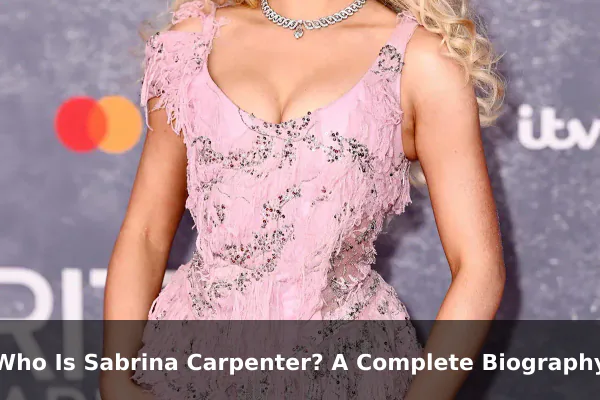
Sabrina Carpenter is an American singer, songwriter, actress, and performer whose career has grown from childhood auditions and Disney Channel visibility into a major pop music profile. For many viewers, she first became recognizable as Maya Hart on Girl Meets World. For many music listeners, she is now known for sharp pop songwriting, polished vocals, witty stage presence, and a career breakthrough that turned years of steady work into global recognition.
This complete Sabrina Carpenter biography follows her path from Pennsylvania to television, film, Broadway, and international pop success. It covers her early life, Disney Channel breakthrough, major albums, acting roles, awards history, artistic style, public image, and current career status. Because Carpenter is a living artist with an active career, the most reliable details come from official artist channels, current and former label materials, the Recording Academy, and certification databases such as the RIAA.
What makes Sabrina Carpenter’s story especially interesting is that she did not appear overnight. Her public rise has been gradual: early online singing videos, youth acting roles, a Disney sitcom, multiple Hollywood Records albums, a more personal creative reset with Island Records, and then the pop-world impact of Emails I Can’t Send, Short n’ Sweet, and the later career chapter represented by Man’s Best Friend.
Early Life and Background

Sabrina Annlynn Carpenter was born on May 11, 1999, in Pennsylvania, with many public biographies identifying Quakertown or the broader Lehigh Valley area as her birthplace. She was raised in a family environment that supported creative ambition, and her early interest in performance centered strongly on singing. Long before she became a Grammy-winning pop artist, Carpenter was a young vocalist learning how to connect emotion, melody, and performance.
Her family background is often mentioned in artist profiles because it helps explain how early her entertainment path began. She grew up with sisters and has spoken in different public settings about developing her imagination away from the pressure of a major entertainment city. That early distance from Hollywood became part of her story: she was not born into a mainstream pop machine, but she was determined to reach one.
Childhood Interest in Singing
Carpenter began building her identity as a singer when she was still very young. Like many artists of her generation, she used online platforms to share cover performances and demonstrate vocal ability before traditional industry attention fully arrived. Those early videos mattered because they showed two traits that continued throughout her career: a clear interest in pop vocals and a willingness to be visible while still developing.
As a child performer, Carpenter entered a landscape where young artists were expected to act, sing, dance, promote, and adapt quickly. Her later career suggests that those early years helped her build stamina. By the time she became known to Disney Channel audiences, she had already spent years preparing for the combination of acting and music that would define her public profile.
Moving Toward Professional Work
Carpenter’s move toward professional entertainment involved auditions, early credits, and steady training rather than one single breakthrough moment. This matters in a biography because it shows that her later fame was built on accumulated experience. Her image today may feel glossy and effortless, but the foundation was practical: voice work, acting practice, screen auditions, stage confidence, and learning how to perform for cameras as well as live audiences.
How Sabrina Carpenter Started Her Career
Sabrina Carpenter’s early career began with small screen appearances and music opportunities that introduced her to professional production environments. One of her first widely noted acting credits came through television, and she gradually moved from guest roles to more visible parts. These early jobs helped her understand pacing, dialogue, character work, and the demands of filming schedules.
At the same time, she pursued music seriously. Her early relationship with Hollywood Records, the Disney-connected label that released her first major projects, placed her in a familiar path for young multi-hyphenate performers: television visibility supported music exposure, and music releases helped deepen fan loyalty beyond the screen.
Early Acting Credits
Before Girl Meets World, Carpenter appeared in roles that gave her industry experience without yet making her a household name. Those appearances were important because they allowed casting teams and young viewers to see her range. She was not only a singer trying to act; she was building both sides of her career at once.
In biography terms, this dual-track development is essential. Many young Disney-era performers become famous through a single defining role, but Carpenter’s later success came from turning that early platform into a broader creative career. Her acting credits gave her visibility, while music gave her a personal voice.
First Music Releases
Carpenter’s early music introduced her as a young pop vocalist with bright melodies, clean production, and age-appropriate themes. Her debut EP, Can’t Blame a Girl for Trying, and her early Hollywood Records albums positioned her inside the teen-pop and Disney-adjacent music world. These releases are sometimes viewed as a separate era from her later music, but they are important because they show the beginning of her recording discipline.
Her first studio album, Eyes Wide Open, arrived during her Disney period and reflected a youthful singer still defining her tone. Later, EVOLution pushed her further into pop production and helped her begin shaping a more independent sonic identity. The progression from these early records to her later work shows how Carpenter gradually shifted from label-guided teen pop toward sharper, more self-aware songwriting.
Disney Channel Breakthrough
Sabrina Carpenter’s breakthrough came when she played Maya Hart on the Disney Channel series Girl Meets World, a sequel series connected to the beloved sitcom Boy Meets World. Maya was the rebellious, funny, emotionally layered best friend of Riley Matthews, and the role gave Carpenter a character that young audiences could remember clearly.
The show ran during a key period in Carpenter’s development. It gave her a broad fan base, placed her in the Disney Channel ecosystem, and allowed her to become familiar to viewers who might later follow her music. Unlike a one-off child-star moment, Girl Meets World gave her repeated exposure over multiple seasons.
Why Maya Hart Mattered
Maya Hart stood out because she was not simply comic relief. She had humor, attitude, vulnerability, and emotional backstory. Carpenter’s performance gave the character warmth, which helped audiences see her as more than a supporting best friend. That kind of role is valuable for a young actor because it asks for timing, emotional range, and chemistry with an ensemble cast.
For Carpenter, the show also created a bridge between acting and music. Disney Channel fans were already used to performers who could sing and act, so her music releases during this period felt natural rather than separate. The platform helped her build an early audience that would later grow with her.
Transitioning Beyond Disney
Leaving a Disney-associated image behind can be difficult for any artist. Carpenter’s transition was gradual and carefully built. She did not immediately abandon acting, nor did she rush into an extreme reinvention. Instead, she continued releasing music, booking film roles, and experimenting with a more mature pop sound. This measured transition helped her avoid being defined only by one television role.
Sabrina Carpenter’s Music Career
Sabrina Carpenter’s music career is the center of her current public identity. While she remains an actress, her growth as a recording artist has become the most visible part of her biography. Her discography moves from early Hollywood Records pop releases to the more personal and commercially powerful Island Records era.
Her early albums built the foundation. Eyes Wide Open introduced her as a young singer. EVOLution showed more rhythmic pop ambition. Singular: Act I and Singular: Act II pushed further into confidence, theatrical delivery, dance-pop, and R&B-influenced textures. Hollywood Records press materials from that period emphasized her growth as a writer and performer, especially around the Singular projects.
The Hollywood Records Era
The Hollywood Records years were formative. Carpenter released multiple albums, toured, developed a fan base, and learned how to translate studio songs into live performances. Singles such as Thumbs, Why, Almost Love, and Sue Me helped define this chapter. Official former-label materials also note that Thumbs and Why earned gold certifications during that phase, showing that her music career was already gaining measurable traction before her later mainstream explosion.
Artistically, the Singular era was especially important because it showed Carpenter leaning into sharper confidence. The songs were more stylized, the visuals were stronger, and the writing began to reveal the wit that later became central to her brand. Even if casual listeners discovered her later, longtime fans often point to this period as the proof that her pop instincts were developing years before the general public caught up.
The Island Records Era
Carpenter’s move to Island Records marked a major creative reset. Emails I Can’t Send, released in 2022, became a turning point because it presented a more personal, conversational, and emotionally direct version of her songwriting. The album’s title itself suggested confession, restraint, and the tension between private emotion and public communication.
The deluxe material and singles connected to this era, including Nonsense and Feather, helped expand her audience. Nonsense became especially associated with her live humor because she often improvised playful outros during performances. This was not just a viral trick; it reinforced a key part of Carpenter’s artistic identity: precise pop structure paired with personality that feels spontaneous.
Short n’ Sweet and Mainstream Pop Breakthrough
Short n’ Sweet represented Carpenter’s full mainstream pop breakthrough. The album included major singles such as Espresso, Please Please Please, and Taste, which pushed her into a larger global conversation. The project combined glossy production, concise hooks, flirtatious humor, and lyrical control. It also helped transform her from a former Disney performer with a loyal fan base into one of the defining pop figures of her moment.
The Recording Academy’s official profile lists Short n’ Sweet as the winner of Best Pop Vocal Album at the 67th Annual Grammy Awards, while Espresso won Best Pop Solo Performance. Those wins are among the clearest official markers of her elevation from rising star to award-recognized pop artist.
Man’s Best Friend and the Next Chapter
As of June 2026, Carpenter’s official website highlights Man’s Best Friend as an out-now release, and her official store and Grammy profile connect the project to her current era. The Recording Academy lists Man’s Best Friend and Manchild among her 68th Annual Grammy Awards nominations. Because release campaigns, tour dates, and certifications can change, the safest approach for current details is to check her official website, Island Records pages, the Recording Academy, and RIAA database entries.
Acting Roles Beyond Disney
Sabrina Carpenter’s acting career continued after Girl Meets World, and her film choices helped her avoid being remembered only as a Disney Channel actor. She appeared in projects that targeted different audiences, including teen comedies, dramas, and stage work. This gave her a broader entertainment profile while music became increasingly central.
Film and Streaming Projects
Her post-Disney screen credits include The Hate U Give, Tall Girl, The Short History of the Long Road, Work It, and Clouds. Hollywood Records’ archived press materials identify her as both the star and executive producer of Netflix’s Work It, a detail that matters because it shows her moving beyond performance into a more active creative role.
The Short History of the Long Road is also notable because official former-label materials connect the film to recognition at the SCAD Savannah Film Festival. This kind of credit helped position Carpenter as an actor capable of more grounded work, not just bright sitcom performance.
Broadway and Stage Work
Carpenter was cast as Cady Heron in Mean Girls on Broadway in 2020, a milestone noted in official Hollywood Records press material. Although the timing of that Broadway run was affected by the shutdown of live theater during the COVID-19 pandemic, the casting itself remains an important career marker. It demonstrated that industry professionals saw her as a performer capable of carrying a demanding musical theater role.
Stage work also connects naturally to Carpenter’s music career. Her concerts often use theatrical pacing, comic timing, stylized visuals, and character-like confidence. Even when she is performing as herself, her stage presence reflects an actor’s understanding of timing and audience attention.
Major Achievements, Awards, and Certifications
Sabrina Carpenter’s achievements are best understood in layers: early fan loyalty, certified singles, major acting credits, award nominations, Grammy wins, and current recognition as a leading pop artist. Because awards and certifications update over time, official databases are the most reliable sources for exact status.
Grammy Recognition
The Recording Academy’s official artist profile lists Carpenter with 2 Grammy wins and 12 nominations. At the 67th Annual Grammy Awards, she won Best Pop Solo Performance for Espresso and Best Pop Vocal Album for Short n’ Sweet. The same official profile also lists additional nominations connected to Short n’ Sweet, Please Please Please, Manchild, and Man’s Best Friend.
These Grammy details are significant because they show that Carpenter’s breakthrough was not only commercial or viral. It was also recognized by music-industry voters. In an artist biography, that distinction matters: a viral hit can make an artist visible, but Grammy recognition helps mark institutional acknowledgment of craft, performance, and recording impact.
RIAA Certifications
The RIAA Gold & Platinum database is the official U.S. source for music certifications. Carpenter’s catalog includes certified songs from earlier and later stages of her career, including Hollywood Records-era singles and newer Island Records-era releases. Certifications are important because they measure commercial thresholds rather than popularity claims or fan estimates.
When discussing Carpenter’s certified work, careful wording matters. Certifications can be upgraded over time, and newly released songs may not immediately reflect their eventual commercial reach. For the most current certification status of songs such as Espresso, Please Please Please, Taste, Feather, Thumbs, and Why, the RIAA database remains the appropriate official reference.
Career Milestones Worth Remembering
- Disney breakthrough: She became widely known as Maya Hart on Girl Meets World.
- Early recording career: She released multiple projects through Hollywood Records, including Eyes Wide Open, EVOLution, and the Singular albums.
- Creative reset: Emails I Can’t Send helped define a more personal songwriting voice.
- Pop breakthrough: Short n’ Sweet brought her biggest mainstream music moment to date.
- Grammy wins: She won Best Pop Vocal Album for Short n’ Sweet and Best Pop Solo Performance for Espresso.
- Current era: Man’s Best Friend and Manchild are tied to her active 2026 career chapter.
Public Image, Style, and Artistic Identity
Sabrina Carpenter’s public image blends polished pop glamour with humor, directness, and theatrical self-awareness. She often presents herself as glamorous without seeming distant, playful without seeming careless, and witty without abandoning emotional detail. This balance is a major reason her audience has expanded beyond people who knew her from Disney Channel.
Songwriting Personality
Carpenter’s songwriting is frequently built around compact phrases, double meanings, and conversational lines that sound casual but are carefully shaped. Her best-known songs often use humor as a doorway into desire, insecurity, pride, embarrassment, or romantic frustration. That approach makes her music feel accessible while still giving listeners lines to quote and remember.
Her later work also shows a strong understanding of character. Songs like Nonsense, Espresso, and Please Please Please do not only deliver hooks; they create a persona. The narrator is clever, dramatic, self-aware, and sometimes knowingly unserious. That is part of Carpenter’s appeal: she understands that modern pop performance is not only sound, but voice, timing, costume, video, and attitude.
Fashion and Stage Presence
Fashion is another part of Carpenter’s artistic identity. Her styling often uses classic pop-star references, bright stage silhouettes, retro touches, and highly coordinated tour visuals. She can appear sweet, glamorous, comic, or commanding depending on the performance context. This visual flexibility supports her music because her songs also move between confidence, vulnerability, flirtation, and humor.
On stage, Carpenter’s background as an actor is easy to see. She understands pauses, facial expressions, audience reactions, and the value of a memorable small moment. Her live performances often feel carefully produced while leaving room for personality, which is why clips from her shows travel well online.
Personal Life and Public Attention
Public curiosity around Sabrina Carpenter’s personal life is intense, especially because her lyrics often invite listeners to connect songs with real experiences. However, a responsible biography should separate verified career facts from speculation. Carpenter is a public figure, but not every rumor, social media theory, or fan interpretation belongs in a factual artist biography.
What can be said carefully is that public attention around her relationships, friendships, and celebrity circles has sometimes shaped how listeners discuss her music. That does not mean every song should be treated as a literal diary entry. Pop songwriting often blends personal experience, character, exaggeration, humor, and collaboration. Carpenter’s work is strongest when understood as crafted art, not merely as gossip material.
Why Rumor-Based Biography Is Risky
For living artists, rumor-based writing can quickly become inaccurate or unfair. Details about private relationships, family dynamics, and personal decisions may change, remain unconfirmed, or be misunderstood outside context. That is why this biography focuses on official career milestones, public creative work, awards history, and verified releases.
This approach also respects Carpenter’s development as an artist. Her career deserves to be analyzed through albums, performances, acting roles, songwriting, and professional achievements rather than reduced to online speculation.
Recent Career and What She Is Known For Today
Today, Sabrina Carpenter is known primarily as a pop artist with a strong songwriting identity, a successful acting background, and a public image that combines glamour with wit. She is also recognized as one of the clearest examples of a former Disney-associated performer who built a second, larger chapter as an adult recording artist.
Her recent career is defined by the Island Records era, Grammy recognition, and the expansion of her fan base beyond early television viewers. Official current materials highlight Man’s Best Friend, while the Recording Academy profile lists recent nominations tied to Manchild and Man’s Best Friend. These details show that her career remains active and still developing.
Why Her Audience Expanded
Carpenter’s audience expanded because several elements arrived at the same time: stronger songwriting, clearer visual identity, confident live performance, viral moments that were supported by real craft, and songs that worked both online and in traditional pop spaces. She did not rely only on nostalgia for her Disney past. Instead, she built a catalog that gave new listeners a reason to stay.
Her growth also reflects a broader shift in pop culture. Audiences now follow artists across television, streaming, concerts, short-form video, interviews, fashion, and awards shows. Carpenter’s career fits that environment because she has experience in all of those spaces. She can perform a tightly produced song, deliver a comic line, carry a screen role, and turn a live-show moment into a fan conversation.
Sabrina Carpenter Biography Quick Facts
| Fact | Details |
|---|---|
| Full name | Sabrina Annlynn Carpenter |
| Date of birth | May 11, 1999 |
| Birthplace | Public biographies commonly list Quakertown or the Lehigh Valley area of Pennsylvania, United States |
| Professions | Singer, songwriter, actress, performer |
| Best-known Disney role | Maya Hart in Girl Meets World |
| Early label | Hollywood Records |
| Current label era | Island Records |
| Notable albums | Eyes Wide Open, EVOLution, Singular: Act I, Singular: Act II, Emails I Can’t Send, Short n’ Sweet, Man’s Best Friend |
| Notable songs | Thumbs, Why, Nonsense, Feather, Espresso, Please Please Please, Taste, Manchild |
| Grammy history | The Recording Academy lists 2 wins and 12 nominations for Carpenter |
| Official source notes | Use Sabrina Carpenter’s official website, Island Records, Hollywood Records archives, GRAMMY.com, and the RIAA database for updated facts |
Essential Sabrina Carpenter Albums and Eras
For readers discovering Sabrina Carpenter for the first time, her catalog is easiest to understand by era rather than only by release date. Each era reflects a different stage of artistic control, vocal maturity, and public identity.
- Early Hollywood Records era: Can’t Blame a Girl for Trying and Eyes Wide Open introduced Carpenter as a young pop vocalist connected to the Disney audience.
- Growth era: EVOLution and the Singular albums showed stronger pop instincts, more confidence, and more mature production choices.
- Personal reset: Emails I Can’t Send made her songwriting feel more direct, specific, and emotionally adult.
- Mainstream breakthrough: Short n’ Sweet turned Carpenter into a central figure in contemporary pop and earned major Grammy recognition.
- Current chapter: Man’s Best Friend represents her active 2026 era and shows her career continuing after the breakthrough rather than stopping at it.
Conclusion
Sabrina Carpenter’s biography is the story of an artist who built a career in stages. She began as a young performer with a strong interest in singing, gained major visibility through Disney Channel, continued acting across film and stage, and spent years refining her music before reaching her biggest pop breakthrough. Her journey shows the difference between sudden fame and long-term development.
Today, Carpenter is known not only as a former Disney star, but as a Grammy-winning pop artist with a distinct voice, a sharp sense of humor, and a carefully built performance identity. From Maya Hart to Espresso, from Hollywood Records to Island Records, and from early teen-pop releases to the current Man’s Best Friend era, Sabrina Carpenter has turned persistence into a versatile and still-evolving career.
Official references
- Sabrina Carpenter Official Website – Primary source for official announcements, releases, tour information, credits, and current artist branding.
- Island Records – Sabrina Carpenter – Official current-label source for Sabrina Carpenter releases and merchandise tied to recent albums and singles.
- Hollywood Records – Sabrina Carpenter Press Page – Official former-label press source for early career releases, Disney-era music, and archived biographical details.
- GRAMMY.com – Sabrina Carpenter Artist Profile – Official Recording Academy source for Grammy nominations, wins, categories, and award history.
- RIAA Gold & Platinum Database – Official U.S. certification database for verifying gold, platinum, and multi-platinum music certifications.
