
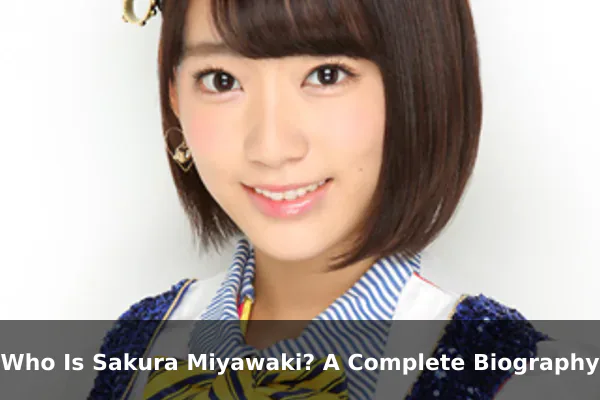
Sakura Miyawaki is a Japanese artist whose career has moved through three major idol systems: HKT48, IZ*ONE, and LE SSERAFIM. That path makes her one of the most recognizable cross-border performers in modern Asian pop, not only because she has worked in Japan and South Korea, but because she has repeatedly adapted to new languages, training cultures, audiences, and performance expectations.
For many fans, Sakura is best known today as SAKURA of LE SSERAFIM, the SOURCE MUSIC girl group under HYBE that debuted in 2022. Long before that, however, she had already spent years building her name in the Japanese idol world as a first-generation HKT48 member, an AKB48 Team A affiliate, and later a member of the project group IZ*ONE. Her biography is not a simple debut-to-fame story. It is a long professional timeline shaped by reinvention, persistence, and a rare ability to remain relevant across different eras of pop entertainment.
This complete biography of Sakura Miyawaki focuses on verified public information from official profiles and agency announcements. It covers her early life in Kagoshima, her HKT48 and AKB48 years, her Produce 48 and IZ*ONE breakthrough, her current role in LE SSERAFIM, and the artistry that has made her a lasting figure in both J-pop and K-pop.
Quick Facts About Sakura Miyawaki

Sakura Miyawaki is professionally known by the stage name SAKURA in LE SSERAFIM. Her official Japanese LE SSERAFIM profile lists her birth date as March 19, 1998, while the AKB48 official election profile records her birthplace as Kagoshima Prefecture, Japan. Her current Japanese management profile at A.M.Entertainment also lists her height as 163 cm and blood type as A.
| Fact | Details |
|---|---|
| Full name | Sakura Miyawaki |
| Japanese name | Miyawaki Sakura |
| Stage name | SAKURA |
| Date of birth | March 19, 1998 |
| Birthplace | Kagoshima Prefecture, Japan |
| Nationality | Japanese |
| Current group | LE SSERAFIM |
| Current group agency | SOURCE MUSIC, a label under HYBE |
| Former affiliations | HKT48, AKB48 Team A, IZ*ONE |
As of the latest official SOURCE MUSIC profile, LE SSERAFIM consists of five members: SAKURA, KIM CHAEWON, HUH YUNJIN, KAZUHA, and HONG EUNCHAE. The official group profile also states that LE SSERAFIM debuted on May 2, 2022, and explains that the group name is an anagram of I’m Fearless. That concept matters when discussing Sakura because her current image is built around confidence, discipline, and forward motion, which are also recurring themes in her career.
Official Profiles Used for This Biography
The most important official anchors for this biography are the SOURCE MUSIC LE SSERAFIM profile, the LE SSERAFIM Japan SAKURA profile, the A.M.Entertainment Sakura Miyawaki profile, the HKT48 graduation announcement, and the AKB48 official election candidate profile. These sources help separate confirmed facts from fan speculation, which is especially important for a long-running artist biography.
Early Life and Start in Kagoshima
Sakura Miyawaki was born on March 19, 1998, in Kagoshima Prefecture, Japan. Kagoshima is located in the southern part of Kyushu, far from the entertainment centers of Tokyo and Seoul that would later define much of her public career. That geographic detail helps explain why her journey stands out: Sakura did not begin as an artist already based in one of the most visible entertainment capitals. She entered the industry through HKT48, a Fukuoka-based sister group within the larger AKB48 system.
Because official profiles keep her personal childhood details limited, a careful biography should avoid inventing private background stories. What can be said with confidence is that Sakura entered professional idol life at a young age. Her AKB48 official profile identifies her debut generation as HKT48 first generation, placing her among the original members who helped define the group from its early period.
Why Her Early Start Matters
Starting in entertainment as a teenager shaped Sakura’s later strengths. Japanese idol groups often emphasize live stages, fan events, variety appearances, theater performances, and a close relationship with supporters. This system can be demanding because it asks young performers to grow in public. Sakura’s early years gave her direct experience with stage repetition, audience awareness, and the emotional discipline needed to continue improving while under constant public observation.
That foundation would later become crucial when she moved into Korean idol work. K-pop places intense emphasis on synchronized performance, polished visuals, recording discipline, choreography, and global media communication. Sakura’s career is unusual because she has experienced both worlds deeply rather than briefly sampling one as a guest or transfer artist.
HKT48 and AKB48 Years

Sakura Miyawaki’s first major public identity came through HKT48. The AKB48 official candidate profile lists her as part of HKT48’s first generation and records her affiliation at that time as AKB48 Team A. This means she was not only connected to a regional sister group but also participated within the broader AKB48 structure, one of the most influential idol systems in Japan.
HKT48’s official graduation announcement, published in May 2021, summarized Sakura’s career by noting that she had been active since 2011 as a first-generation HKT48 member, as an AKB48 selected member, and as an IZ*ONE member. That official statement is important because it frames her first decade in entertainment as a continuous professional run rather than disconnected chapters.
Growth Inside the 48 Group System
The 48 group system is built around teams, theater stages, singles, elections, handshake events, and visible member development. For a performer like Sakura, it offered many different types of exposure. She could appear on stage, interact with fans, take part in group releases, and compete for visibility inside a large roster. This environment rewarded consistency as much as instant impact.
Her AKB48 election candidate profile shows that she became increasingly prominent over time. The official page lists past election results of 47th in 2012, 26th in 2013, 11th in 2014, 7th in 2015, and 6th in 2016. Those results reflect a steady rise within a fan-voted system, and they help explain why Sakura was already a known name before Korean viewers encountered her through Produce 48.
Graduation From HKT48
On May 15, 2021, HKT48 announced that Sakura had requested graduation from the group. The announcement stated that she would end her HKT48 activities at a graduation concert held on June 19, 2021. It also thanked fans and people connected to her career for supporting her across roughly ten years of activity.
This graduation was more than a normal group departure. It marked the close of Sakura’s first major artistic era. By that point, she had already worked in the 48 group structure, represented HKT48 on larger stages, participated in AKB48-related activities, and gained international visibility through IZ*ONE. Leaving HKT48 allowed her to fully step into the next phase of her career as an artist whose future would be closely tied to the Korean music market.
Produce 48 and IZ*ONE Breakthrough
Sakura’s international profile expanded dramatically through Produce 48, the Korean survival program that brought together trainees from the K-pop system and Japanese idols from the 48 group world. The show was significant because it placed two different idol cultures in direct comparison: the Japanese system of fan-grown idols and the Korean system of intensive trainee performance polish.
For Sakura, Produce 48 was both an opportunity and a challenge. She entered the show already famous in Japan, but that did not mean she could rely only on past recognition. Korean survival programs evaluate contestants through performance missions, audience reactions, editing narratives, peer comparison, and public voting. Sakura had to communicate her appeal to viewers who may not have followed HKT48 or AKB48 closely.
From Japanese Idol Recognition to K-pop Visibility
Her success on Produce 48 led to her becoming a member of IZ*ONE, the Korean-Japanese project group formed through the program. HKT48’s own graduation announcement later identified her as having worked as an IZ*ONE member, confirming the importance of that period in her official career record.
IZ*ONE gave Sakura a new platform. The group promoted in the Korean idol market, released music that reached international fans, and helped introduce several members to audiences beyond their original domestic bases. For Sakura, it meant working in Korean, adapting to K-pop choreography and styling, and participating in a group where the public image was different from HKT48’s theater-centered idol format.
What Changed During the IZ*ONE Era
The IZ*ONE chapter changed how many fans understood Sakura Miyawaki. In Japan, she was already a senior idol with years of activity behind her. In Korea and internationally, she was often introduced as a Japanese member gaining a second breakthrough. That contrast gave her a rare dual identity: established veteran in one market, rising global performer in another.
Several aspects of her public image became more visible during this period:
- Adaptability: She adjusted from Japanese idol conventions to K-pop performance standards.
- Language effort: She communicated with Korean staff, members, and fans while working outside her home country.
- Stage awareness: Her experience helped her understand camera focus, facial expression, and live audience response.
- International appeal: Her fanbase grew beyond Japan and Korea into wider global K-pop spaces.
By the time the IZ*ONE period ended, Sakura was no longer only a Japanese idol with an overseas project. She had become a cross-border artist whose next career decision was closely watched by fans in multiple countries.
Joining LE SSERAFIM
Sakura’s current group is LE SSERAFIM. According to SOURCE MUSIC’s official profile, the group debuted on May 2, 2022, under SOURCE MUSIC, a label under HYBE. The same official profile lists the five current members as SAKURA, KIM CHAEWON, HUH YUNJIN, KAZUHA, and HONG EUNCHAE. Sakura’s official Japanese LE SSERAFIM profile separately confirms her stage name as SAKURA and her birth date as 1998.3.19.
This debut was one of the most important turning points of her career. Unlike IZ*ONE, which was a project group with a limited promotional period, LE SSERAFIM positioned Sakura inside a continuing K-pop group backed by a major company structure. It also reunited her professionally with Kim Chaewon, another former IZ*ONE member, while placing both of them alongside new teammates with different backgrounds.
The Meaning of LE SSERAFIM’s Concept
SOURCE MUSIC explains that LE SSERAFIM is an anagram of I’m Fearless. The concept centers on confidence, self-determination, and facing the world without hesitation. For Sakura, this theme fits naturally with the visible arc of her career. She left a familiar Japanese idol environment, entered a Korean survival program, joined an international project group, graduated from HKT48, and then debuted again in a new K-pop group.
That sequence required more than popularity. It required risk tolerance. Many artists build recognition in one market and remain there. Sakura chose a path that repeatedly placed her in new systems where she had to prove herself again. LE SSERAFIM gave her a platform where that history could become part of her strength rather than a burden.
Her Role in the Group
Official profiles do not need to reduce Sakura to a single role. In LE SSERAFIM, she contributes as a performer with long experience, a Japanese member who helps broaden the group’s cultural reach, and a public figure with an existing international fanbase. Her value is not only technical; it is also historical. She brings the perspective of someone who has already lived through multiple versions of idol fame.
This makes her presence especially meaningful in a group aimed at global audiences. LE SSERAFIM’s music, choreography, visuals, and messaging often emphasize resilience and forward momentum. Sakura’s biography gives that image real context because fans can trace her career through years of reinvention.
Artistry, Performance Style, and Public Image
Sakura Miyawaki’s artistry is best understood through longevity and adaptation. She is not a performer whose reputation rests on a single viral moment. Instead, she has built her career through accumulated experience: theater stages, Japanese idol promotions, survival show missions, Korean music broadcasts, global K-pop schedules, magazine work, advertising, and fan communication.
Performance Strengths
Sakura’s performance style has evolved with each stage of her career. In the 48 group system, idols often learn to hold attention through expression, personality, and audience connection. In K-pop, performers are expected to deliver sharper synchronization, more precise formations, and a consistent visual identity across broadcasts and concerts. Sakura’s development shows the influence of both.
Her strengths can be summarized in several areas:
- Camera awareness: Years of stage and broadcast experience help her understand how to project emotion through close-up shots and performance angles.
- Professional consistency: Her long career suggests a strong ability to keep working through changing schedules and public expectations.
- Concept adaptation: She has moved from Japanese idol brightness to IZ*ONE’s elegant image and LE SSERAFIM’s confident, modern style.
- Fan connection: She has maintained a large following across Japan, Korea, and international fandom spaces.
- Resilience: Re-debuting after already being established requires discipline, humility, and willingness to train again.
Public Image
Sakura is often viewed as a symbol of professional reinvention. Fans admire that she did not stop after achieving fame in Japan. Instead, she continued to seek new challenges, even when doing so meant starting over in a different entertainment system. That choice has become central to her identity as an artist.
Her public image also benefits from a sense of transparency. Because she has been active for so long, audiences have watched her grow from a teenage idol into an adult performer. This long timeline creates emotional investment. Fans do not only follow her current work; they remember previous eras, group transitions, and the choices that brought her to the present.
Acting, Variety, Fashion, and Individual Activities
Sakura Miyawaki’s individual activities extend beyond group performance. Her A.M.Entertainment profile highlights magazine appearances and advertising work, including fashion and beauty-related projects. The profile lists magazines such as Numéro TOKYO, SPUR, Harper’s BAZAAR, and sweet, and advertising or brand-related work connected with names such as &be HAIR, Digital Hollywood University, LILY BROWN, LOUIS VUITTON, CRAN BY MOLAK, and MOLAK.
These activities matter because they show Sakura’s appeal outside the narrow frame of idol stages. Fashion magazines and advertising campaigns often depend on visual identity, brand compatibility, and public recognition. Sakura’s continued presence in these areas suggests that agencies and brands see her as more than a group member. They see her as an individual artist with a recognizable image.
Fashion and Beauty Presence
Sakura’s fashion and beauty work fits naturally with her career. She has been associated with polished styling in both Japanese and Korean entertainment, and her public image can move between elegant, youthful, chic, and performance-driven concepts. That flexibility is valuable for magazines and brands because it allows her to represent different moods without losing recognizability.
Her Japanese management profile currently emphasizes this part of her career, which is useful for readers who want to understand her solo market presence. While fans may know her through music first, her individual profile shows that her career also includes visual media, commercial partnerships, and print-related work.
Variety and Media Skills
Years in Japanese idol entertainment also gave Sakura experience with variety-style communication. The 48 group system often places members in situations where personality, humor, reaction, and quick adaptation matter. Those skills can be less visible than dance or singing, but they are important for maintaining a public career over time.
In Korean idol settings, variety content, behind-the-scenes videos, fan platforms, and interviews are major parts of promotion. Sakura’s background helps her navigate those formats. She can participate as an experienced idol while still presenting herself as someone who continues to learn and evolve.
Why Sakura Miyawaki’s Career Stands Out
Sakura Miyawaki’s career stands out because it crosses boundaries that many artists never cross. She did not simply move from one group to another within the same system. She moved from HKT48 and AKB48’s Japanese idol culture into IZ*ONE’s Korean-Japanese project structure, then into LE SSERAFIM’s global K-pop framework. Each step required new expectations, new collaborators, and new public narratives.
A Rare Multi-Era Idol Career
Many idol careers are short because the industry is physically and emotionally demanding. Sakura’s career is notable because she has remained active and visible through more than one major entertainment era. Her HKT48 debut placed her in the early 2010s Japanese idol boom. IZ*ONE connected her to the late 2010s globalization of K-pop survival groups. LE SSERAFIM positioned her in the 2020s era of internationally targeted K-pop groups backed by large-scale digital promotion.
That multi-era timeline gives Sakura a special kind of credibility. She understands fandom from the theater stage, the televised survival show, the temporary project group, and the permanent K-pop group. Few artists can claim such a broad range of experience.
Cross-Border Influence
Sakura also represents the increasing connection between Japanese and Korean pop industries. Her career shows how artists can move across markets while keeping their original identity. She remains Japanese, but her current work is deeply tied to Korean pop production and global K-pop fandom. This makes her an important figure for fans interested in how Asian pop cultures interact.
Her influence is especially visible in three ways:
- She helped introduce Japanese idol fans to Korean project-group promotion through IZ*ONE.
- She brought an established Japanese fanbase into LE SSERAFIM’s global audience.
- She showed that re-debuting can be a strategic career move rather than a step backward.
This is why Sakura Miyawaki is often discussed not only as a member of a group, but as an artist whose career path itself has become influential.
Common Questions About Sakura Miyawaki
Is Sakura Miyawaki still in LE SSERAFIM?
Yes. As of the current official SOURCE MUSIC and LE SSERAFIM Japan profiles, SAKURA is listed as a member of LE SSERAFIM alongside KIM CHAEWON, HUH YUNJIN, KAZUHA, and HONG EUNCHAE.
When was Sakura Miyawaki born?
Sakura Miyawaki was born on March 19, 1998. This birth date is confirmed by official Japanese LE SSERAFIM and AKB48 profile materials.
Where is Sakura Miyawaki from?
She is from Kagoshima Prefecture, Japan. The AKB48 official election candidate profile lists Kagoshima Prefecture as her birthplace.
Was Sakura Miyawaki in HKT48?
Yes. She was a first-generation member of HKT48. HKT48’s official graduation announcement states that she had been active from 2011 and ended her HKT48 activities with a graduation concert on June 19, 2021.
Was Sakura Miyawaki in IZ*ONE?
Yes. HKT48’s official graduation announcement identifies her career as including activity as an IZ*ONE member. That period played a major role in expanding her recognition from Japan into the Korean and global idol markets.
Conclusion
Sakura Miyawaki’s biography is the story of an artist who kept moving. She began in Kagoshima, entered entertainment through HKT48’s first generation, rose through the AKB48 system, gained international recognition through Produce 48 and IZ*ONE, and re-debuted as SAKURA of LE SSERAFIM. Each chapter added a different skill set and a different audience, creating a career that is unusually broad for an idol performer.
What makes Sakura Miyawaki important is not only that she has belonged to famous groups. It is that she has continued to adapt while carrying her history with her. Her official career record connects Japanese idol culture, Korean project-group success, and current global K-pop promotion. For fans asking who Sakura Miyawaki is, the answer is clear: she is a Japanese artist, a long-running idol professional, a LE SSERAFIM member, and one of the most significant cross-border performers of her generation.
Official references
- SOURCE MUSIC – LE SSERAFIM Profile – Current label profile for LE SSERAFIM, confirming Sakura's current group, debut date, member lineup, and agency context.
- LE SSERAFIM Japan Official Site – SAKURA Profile – Official Japanese member profile confirming Sakura's stage name and birth date.
- A.M.Entertainment – Sakura Miyawaki Profile – Official Japanese management profile for Sakura's individual activities, with biographical details and work history.
- HKT48 Official Website – Miyawaki Sakura Graduation Announcement – Primary source for her HKT48 graduation announcement and summary of her HKT48, AKB48, and IZ*ONE career period.
- AKB48 Official Site – Election Candidate Profile – Official historical AKB48 profile confirming birth date, birthplace, HKT48 first-generation debut status, AKB48 Team A affiliation, and election history.
